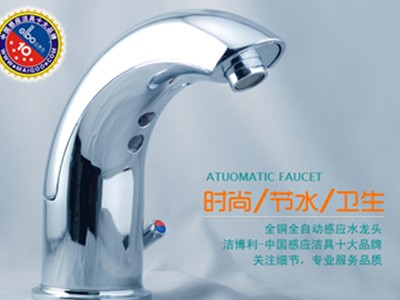
GIBO Sensor Faucet: 24-Hour AASS Acidic Salt Spray Test Technical Specification
Technical Summary of the 24-Hour Acidic Salt Spray Test. The 24-hour AASS (Acetic Acid Salt Spray) test is an authoritat

1. Technical Overview
The 24-Hour Copper-Accelerated Acetic Acid Salt Spray (CASS) Test is a high-grade accelerated corrosion reliability method for bathroom hardware and sensor sanitary ware, serving as the core validation protocol for GIBO’s patented anti-corrosion technology in sensor faucets and our full range of sensor products. While most industry brands rely on the basic AASS (Acetic Acid Salt Spray) test, GIBO adopts the more stringent CASS standard to significantly elevate corrosion resistance benchmarks. By simulating a harsh environment with constant high temperature, humidity, and copper-ion-accelerated acidic salt spray, this test rapidly accelerates metal oxidation, plating degradation, and rusting. It accurately replicates long-term exposure to humid, saline, and fluctuating temperature conditions typical of public restrooms and coastal or industrial areas, providing an authoritative assessment of the corrosion resistance and long-term durability of valve bodies and metal structural components in commercial sensor faucets and sanitary ware.
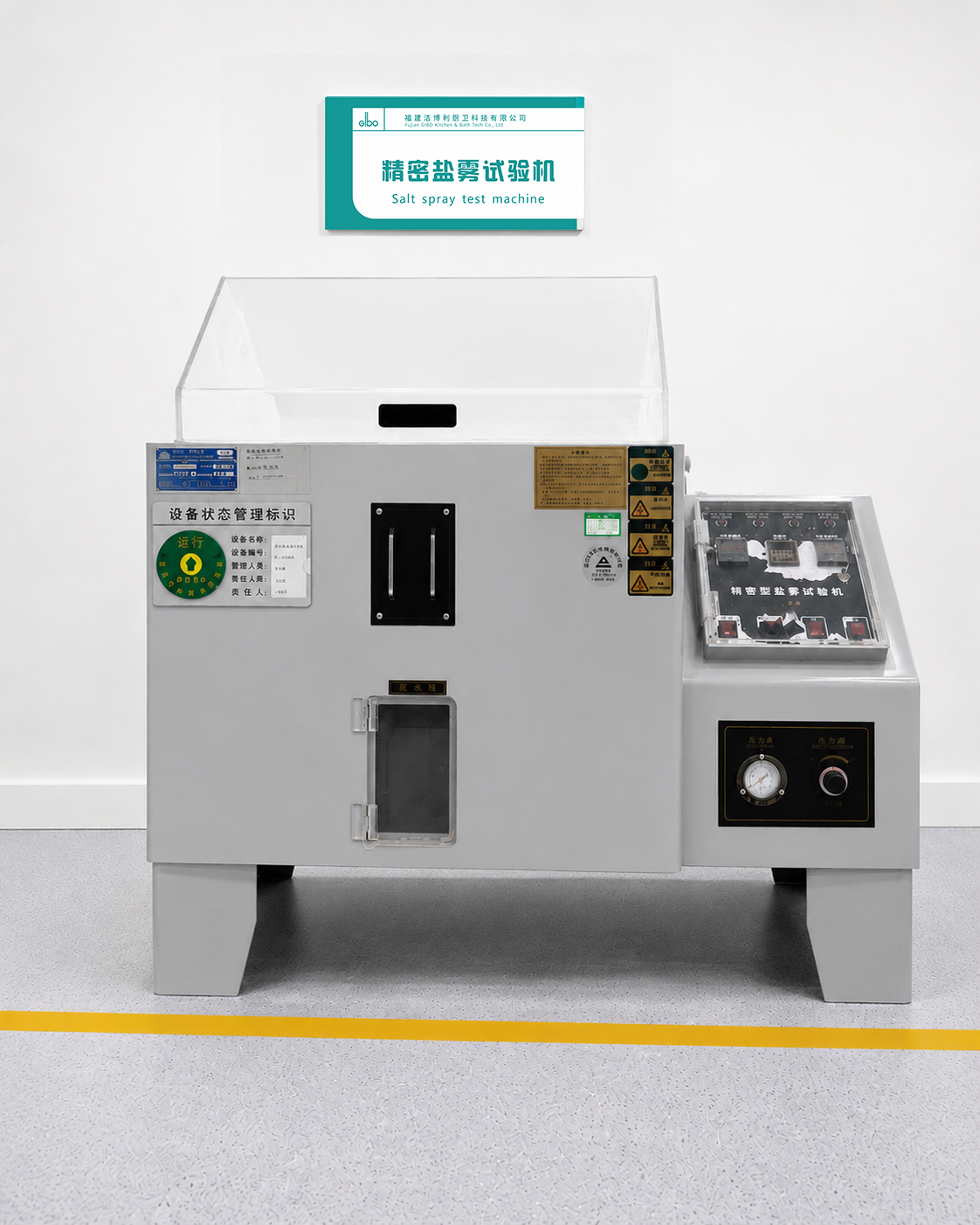
II. Test Principles, Industry Differences Between CASS and AASS, and Standards
This test strictly complies with the Chinese National Standard.GB/T 10125-2021Corrosion Rate Benchmarking: To clearly demonstrate our technical advantage, we distinguish between the industry-standard AASS test and GIBO’s adopted CASS test. The Acetic Acid Salt Spray (AASS) test is the conventional method in the sanitary ware industry. It creates a single acidic salt spray environment using only acetic acid, without accelerators, resulting in a moderate corrosion rate. AASS is primarily used for basic coating quality checks and cosmetic corrosion screening on standard sensor faucets and sanitary products, suitable only for basic acceptance of general commercial bathroom fixtures. However, it fails to detect hidden corrosion defects in precision valve bodies of high-end sensor faucets and sanitary ware. In contrast, the Copper-Accelerated Acetic Acid Salt Spray (CASS) test enhances the pure acidic salt spray basis of AASS by adding precisely formulated copper chloride accelerators. Leveraging the strong catalytic effect of copper ions, CASS increases corrosion intensity and raises the test temperature, creating more severe operating conditions and comprehensive verification dimensions. It accurately replicates complex extreme environments with high pollution, salinity, and humidity. This effectively identifies substrate risks, coating density defects, and structural weak points in sensor sanitary ware and sensor faucets, serving as an advanced validation standard for premium bathroom hardware and precision metal coatings.
To make inspection standards and corrosion grades more transparent, we have consolidated them below.NSS Neutral Salt Spray, AASS Acetic Acid Salt Spray, CASS Copper-Accelerated Acetic Acid Salt SprayMainstream test conversion formulas across three industry categories and the core criteria of the GB/T 6461 nine-level rating system. All conversions are based on authoritative national standards GB/T 10125-2021 and GB/T 6461, ensuring precise and traceable data.
1. Conversion Formula for Three Types of Salt Spray Test Durations
NSS Neutral Salt Spray Test: Industry-standard corrosion test with the lowest corrosion rate, serving as the baseline for corrosion conversion;
AASS Acetic Acid Salt Spray Test (Industry Standard)Corrosion rate = 3× NSS neutral salt spray; conversion formula:24h AASS = 72h NSSequivalent to simulating natural humid conditions and standard bathroom operating environments3-Year Aging Test Results;
CASS Copper-Accelerated Acetic Acid Salt Spray Test (GIBO adopts a higher-tier standard)Corrosion Rate = 8× NSS Neutral Salt Spray; Conversion Formula:24h CASS = 192h NSS, simulating the harsh operating conditions of coastal areas, industrial zones, and high-frequency public restrooms8-Year Natural Aging EffectThis is what the bathroom industry commonly refers to as a 200-hour salt spray test.
2. GB/T 6461: Class 10 Rating, Class 9 Pass Criteria
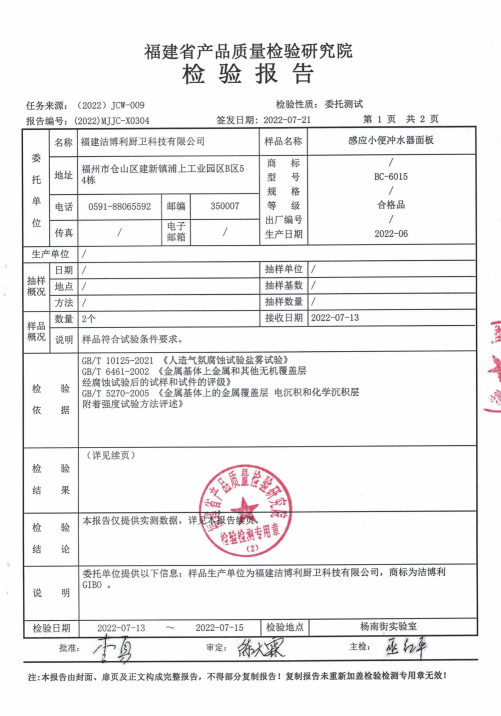
The highest salt spray test rating is Grade 10 (no visible corrosion),Grade 9 is the premium anti-corrosion benchmark for commercial bathroom hardwareand the inspection grade consistently achieved by GIBO sensor sanitary ware and sensor faucet products. Grade 9 criteria: After testing, the product substrate shows no rust, pitting, or through-corrosion; the metallic plating exhibits no peeling, flaking, or blistering. Only extremely minor surface discoloration that does not affect functionality is permitted, with zero functional corrosion defects—fully meeting the demanding long-term commercial use requirements for sensor faucets and sensor sanitary ware.
Overall, GIBO’s CASS testing significantly exceeds industry-standard AASS and NSS tests in terms of corrosion acceleration rate, severity of operating conditions, and simulated natural aging lifespan. Results are strictly evaluated against the GB/T 6461 ten-level metal corrosion rating standard. The entire GIBO range of sensor sanitary ware and sensor faucets consistently passes the rigorous 24-hour high-intensity CASS copper-accelerated salt spray test, achieving stableCorrosion rating of Grade 9 or higherPost-test inspection revealed only minimal surface discoloration, with no corrosion, rust, plating delamination, or substrate erosion—significantly exceeding standard AASS test requirements and achieving a premium corrosion-resistance grade for commercial bathroom hardware and sensor-activated sanitary ware.
The entire test process strictly maintains salt spray pH at approximately 3.0, while leveraging copper ion catalysis to intensify corrosion effects. This results in overall corrosion intensity and harshness of operating conditions significantly exceeding those of industry-standard AASS tests and conventional neutral salt spray tests. Unlike the single acidic AASS test commonly used in the industry, CASS testing accurately replicates multiple complex and severe real-world scenarios, including high salinity in coastal areas, acid-alkali erosion in industrial zones, and prolonged exposure to high-temperature, high-humidity water vapor in public restrooms. It overcomes the limitations of standard AASS testing—insufficient intensity, incomplete verification, and limited coverage of operating conditions—thereby comprehensively validating the extreme corrosion resistance and long-term operational stability of sensor faucets and sensor sanitary ware.
III. Technical Value and Industry Pain Point Solutions
Most brands in the sanitary ware industry rely solely on basic AASS (Acetic Acid Salt Spray) testing, which features low intensity and lenient standards. While sufficient for short-term cosmetic corrosion resistance, this approach fails to verify the durability of sensor faucets and smart sanitary ware under long-term high-salt, high-humidity, and complex operating conditions. Consequently, traditional bathroom hardware and smart sanitary products commonly suffer from rusting, plating peeling or flaking, valve body corrosion, circuit contact oxidation leading to failure, and short service lives. GIBO has upgraded industry testing standards by leveraging proprietary anti-corrosion structural patents and customized premium surface treatment processes. Our entire range of sensor faucets and smart sanitary ware consistently passes the rigorous 24-hour CASS (Copper Accelerated Acetic Acid Salt Spray) test, fundamentally addressing industry shortcomings in corrosion resistance and eliminating testing blind spots.
Precisely validated through CASS accelerated corrosion testing, this technology predicts and prevents latent corrosion failures in sensor faucets and touchless sanitary ware over an 8-year lifespan. It comprehensively enhances the weather resistance, stability, and service life of metal valve bodies and exterior structural components. The products are ideally suited for hotels, hospitals, schools, municipal public restrooms, coastal construction projects, and industrial facilities.High humidity, high salinity, heavy-duty use, and strong corrosionEngineered for complex, demanding environments, GIBO employs an advanced validation system that exceeds standard AASS testing protocols. This establishes a core technological barrier ensuring the long-term durability of commercial sensor sanitary ware and Sensor Faucets, significantly reducing maintenance, repair, and replacement costs while guaranteeing reliable, stable operation over time.